ROSLAG TUNES
Albin, Ceylon & Henry Wallin
Publisher Birgitta Wallin
Translation Anna Abraham
Contents
Birgitta Wallin Introduction
Henry Wallin Dad and Ceylon
Ulla Carin Libert Ceylon's Nyckelharpa Playing
Ole Hjorth Henry's Fiddling
Christian Foged Music and Narration's Expressive Power
Tune Descriptions
The tunes in the original book were transcribed by:
Kurt Ehlert: Tune numbers 10, 26, 44, and the pastoral version of tune number 8.
The stylistic comments to the fiddle music, etc.
Ole Hjorth: All harmonies for fiddle listed in the table of contents that are marked with *
Ulla Carin Libert: All tunes (except for 10, 26 and the pastoral version of tune number 8)
The comments regarding nyckelharpa in the transcriptions.
The remaining texts with the transcriptions were written by Henry Wallin (HW) and Birgitta
Wallin (BW). Those responsible for the transcriptions worked together with Henry Wallin.
Translation: Anna Abraham Publishing: Birgitta Wallin
Introduction
Nyckelharpa player, fiddler and blacksmith Albin Wallin, was born in 1891 in Valö parish, northern Uppland, central Sweden. He inherited a rich folk music legacy from his paternal grandmother, Christina Fredrika (born 1818), his maternal grandfather Matts Bergström (born 1820), his father Frans Adolph, and other fiddlers in the area.
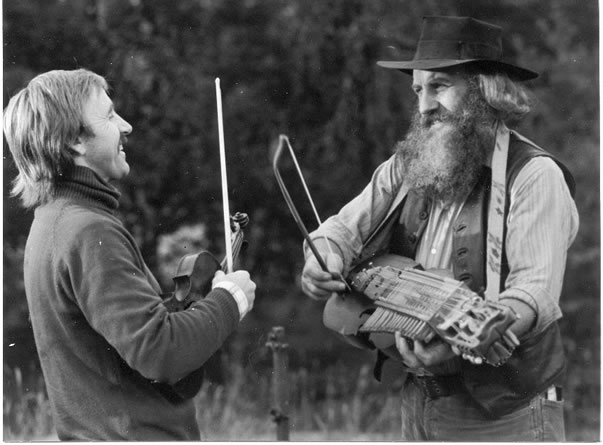
Folk music was Albin's passion in life, and his genuine love of the tunes and respect for the tradition was passed on to his sons Ceylon and Henry. During the late 1960's, Sweden enjoyed a folk music renaissance, and Ceylon became one of Sweden's most well-loved nyckelharpa players.
'Roslag Tunes' with Ceylon and Henry became a well-known concept within the folk music world, and throughout Scandinavia, "dad's tunes" were played at jam sessions, workshops, and concerts. When Ceylon and Henry recorded their 1972 LP record Roslagslåtar, it was widely distributed. After a tour in the United States in 1976, the tunes also reached the American public.
Albin died in 1982, and Ceylon in 1984. To honor their memory, Henry and I decided to document their music on paper. Those who were involved with the transcription work helped us to execute our ideas with sensitivity, experience, and knowledge. We thank them for their invaluable contributions:
Kurt Ehlert, hydrologist and fiddler, has many years of experience working in the folk music movement and as a folk music instructor in Norrköping. He wrote the fiddle commentary with the transcriptions.
Ole Hjorth, fiddler and initiator of the folk music program at the Royal Music Academy in Stockholm, was for many years, their director. He played an important role in the transcription work and specializes in the tunes after the great fiddler, Hjort-Anders, who was also his teacher. Ole wrote the article entitled "Henry's Fiddling".
Ulla Carin Libert, economist and clothing designer, learned to play nyckelharpa from Ceylon in the late 1970's. She has also played together with Henry at various times. She transcribed the main part of the tunes found in the book, and analyzed Ceylon's nyckelharpa playing in her article.
Christian Foged wrote the article "Music and Narration's Expressive Power". He lives in Århus, Denmark, and is active in the Scandinavian folk music community.
Henry Wallin, artist and fiddler, wrote an article about his family: his mother Mathilda, father Albin, and brother Ceylon. He made the final decisions concerning the sheet music and also wrote most of the comments along with the transcriptions. He illustrated the book with many fiddler portraits using pencil and Indian ink drawings.
Anna Abraham, folk musician from Seattle, translated the books Swedish texts. She began playing fiddle in 1994 and nyckelharpa in 1996. She studied folk music at the Sahlström Institute in Tobo, 1999-2000. In connection with a project about Swedish fiddlers that immigrated to America, she visited Henry Wallin to hear about his trip to the United States in 1976. I began to think about a translation of the book Roslag Tunes for our English-speaking, folk music friends. Our contact with Anna and her grandmather June Evanoff, Seattle made this idea possible. Besides her language capabilities, she has a serious love for Swedish folk music and her sensitivity and great generosity has been a joy to work with.
Many friends have helped us complete the Roslag Tune Book. For the English translation, I would like to especially thank my sister, Ann-Marie Blom and brother-in-law Torbjörn Antonsson, in Stockholm, for contributing a great deal of advice and closely editing the texts.
The documentation of the Wallin family musical tradition has been made possible with contributions from the Folk Music Foundation and the King Gustaf VI Adolf Foundation for Swedish Culture, and with phonograms from the Swedish Council for Culture.
Stockholm, June 2004
Birgitta Wallin
 archive