|
The 1996 Nyckelharpa World Championship |
Gunnar Fredelius, translated by Bart Brashers
(from Nyckelharpan 3/96 and Nyckel Notes, January 1997, Number 6)
In 1996 the competition was back in Österbybruk. The jury was composed of Gunnar Ahlbäck, Jan Ling, Nisse Nordström, Curt Tallroth, Sigurd Sahlström and myself (Gunnar Fredelius). As jury members, we get to hear a lot of points of view. They are welcome, too (except maybe for the ones of the type "the wrong tune won" without any explanation). Some questions come up often, which is usually a sign that many others have the similar questions on their minds. I can take this opportunity to answer some of those questions here.
A common question is "what exactly do we base our decisions on?" We have four main criteria that we score, which are then divided into sub-criterion such that the main criteria are worth different amounts. We look at the Choice of Tune (for example, if the tune is well suited to the nyckelharpa). The next point deals with Playing Technique (which includes overall skill, fingering skill, bowing technique, giving shape to the melody, and tone quality). Then we have Folk-music Performance, with seven or eight sub-items that deal with style, ornaments, speed, rhythm, tempo, drones and double-stops. And finally we have the point Musical Expression, which has the hard-to-define elements of overall presentation and impressions.
Another question is how much we take into account nervousness and that it maybe sounds a lot better back at home in the kitchen. Of course, we have some understanding for mistakes, etc., due to nervousness. Even starting a tune over is accepted. But if a player falters too badly, one must understand that part of the competition is to be able to handle the situation. Some players have shown great ability to nicely improvise a solution to a tune that has derailed, and in doing so have turned an error into something positive. But what counts isn't what one has done previously in life, or at home in the kitchen. It would be an altogether different type of competition if one could submit a cassette and show how good one could be. The only thing that counts is the presentation at the competition -- not old merits or sins.
Some people have suggested that the jury should sit behind a sheet. Not so that one doesn't have to see us, I hope, but because it would be more fair if the jury didn't know who was playing. One argument against this is that we could recognize who it is anyway. One of the fascinations with solo nyckelharpa playing is how personal and individual it can be.
"Does the jury think about its responsibility as to setting the standard if it rewards for example a young virtuoso as opposed to the maturity and tradition of an older player?" is one question we have heard. We don't. The questioner wanted to point out the difficulty of weighing for example tradition vs. slick fingers, but that is something we take a stand on before the competition, by establishing and ranking our criterion. In playing for the Zornmärke [the Zorn medal; those who have been awarded the Zorn medal in silver have the honor of being called Riksspelmän] the player is judged against a norm, while at the VM we have only a single winner. The idea is to play well, or better yet best of all the participants.
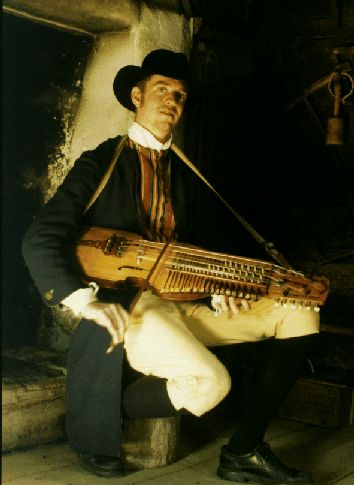
Niklas Roswall photo: Per-Ulf
Allmo
Once a champion, always a champion, even if not the reigning one. "Shouldn't the previous champions be barred from competing so others will have more of a chance?" is one question we've heard. A sympathetic idea. But to keep the quality high at the competitions, we do as all other competitions - both in music and in sports - and give the champ a chance to come back and compete again.
This article has turned out to be more about the competition than the competitors, but at last we turn to the people who entered. 11 musicians played in the gammelharpa class, and a whole 18 in the chromatic class gave the public a first-class show. It is possible that this can seem a little too much for an audience, but they seemed pleased.
In the gammelharpa class, Hasse Gille, Anders Nordfors and Niklas Roswall played kontrabasharpa. Björn Björn, Esbjörn Hogmark, Kurt Södergren, Curt Jinder, Lena Jörpeland, Ingvar Jörpeland, Kjell Landström and Christer Wesström played silverbasharpa. We don't normally say who came in second place, but this year we'll make an exception since it was so close.
Björn Björn presented a formidable show with his two Anderén tunes. There were no imperfections to annotate! Lena Jörpeland did just as well as when she won in 1994. Their playing styles are different, but nothing made the individual styles more clear to the jury than when Niklas Roswall played Gustav III krigsmarsch. After listening and discussions, and more discussions, Lena was chosen over Björn Björn. Thus she became the first to successfully defend her title. That it was a "photo finish" does not detract from her victory in any way.
In the chromatic class, we heard among others Sture Sahlström, with his delightful and genuine old style. Hasse Gille had intended to compete only in the gammelharpa class, but erroneously was placed on the list for the chromatic class as well. To generate an ear-deafening roar from the public is any musician's dream, but Hasse did just the opposite, which is significantly more difficult. He got the public to be absolutely quiet by holding out the silence in one of his tunes to the breaking point. You could have heard a horsehair fall at 50 yards. That's spelman's power embodied, to be able to magically hold an audience like that....
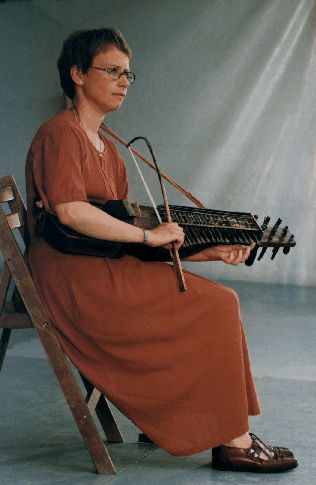
Lena Jörpeland photo: Per-Ulf Allmo
Many of the rest of the players gave perfect performances (none listed, none forgotten) so the entertainment level was very high. To hear all of our top players play solo and so well.... Niklas Roswall played a Halling from Värmland, and a tune after Ivar Tallroth that had just been played by the previous contestant Esbjörn Hogmark. Two insightful interpretations - fairly different. A Tallroth sat on the jury, so we of course knew how Ivar had played it, but on the other hand you don't get any extra points for exactly copying another player. Both players put their mark on the tune. Some said afterwards that one can't play Halling on the nyckelharpa, but we thought Niklas proved that one can. The jury reached the decision to give Niklas the title after only a few hours' discussion. Tongång had promised the winner of the chromatic class the chance to make a CD. Niklas has said "yes" to the offer, and we await the result with interest.
Different methods are used from year to year to decide the winner of the audience's favorite award. One year we measured the response with a decibel meter and a stopwatch. This year, 25 members of the audience were chosen and asked to vote via the more conventional ballot slips. The result was clear, and the winner Niklas Roswall received the customary cittra [zither] from Gottfrid Johansson's music store. Those votes that were not for him were widely distributed, a sign that the overall level was very high. Four female musicians were among those who got votes.
Congratulations to Lena and Niklas!
On the Swedish part of Nyckelharpans Forum you will find lots and lots of photos of the instrument nyckelharpa, the people who play it and the people who build it.